Tout se ressemble. Comment les grands hôtels retrouvent leur singularité.
Ask someone who travels a lot what they truly remember about a palace hotel.
There's always a silence. Then a detail. Never the marble bathroom. Never the room service. Something else — an object, a gesture, something that wasn't planned.
That silence says it all.
Luxury has become a language no one hears anymore.
There's a vocabulary of the international palace hotel that everyone knows and no one notices anymore. The marble. The 600-thread-count linen. The guest's first name said twice. The suite with a view.
All of it is flawless. All of it is expected.
And that's exactly the problem.
What was once distinction has become standard. What was once a promise has become a prerequisite. The guest walking through a palace hotel's doors today is no longer surprised by excellence. They demand it, and move on.
Their eye is searching for something no spec sheet accounts for.
When every palace hotel looks the same, which one do you choose?
The standardization of luxury isn't an accident. It's the logical result of decades of benchmarks, certifications, shared references. We wanted to guarantee quality everywhere. We succeeded.
Along the way, we also manufactured a kind of indifference.
A palace hotel in Hong Kong now looks like one in Milan. Not for lack of talent among the teams. But because the suppliers are sometimes the same, the standards converge, and geography fades away.
Guests feel it. They may not say it. But there's a moment — a slight disappointment — when they realize they could be anywhere else and the experience wouldn't really change.
It's a quiet crisis. And the houses that sense it first have a head start.
The quiet return of objects that tell a story.
What's happening in response is interesting. Not a revolution. A slow reorientation.
Some establishments are turning back to local artisans. Not to check a box. To recover something irreducible. A fabric you won't find in a catalog. An object that says: here, not anywhere else.
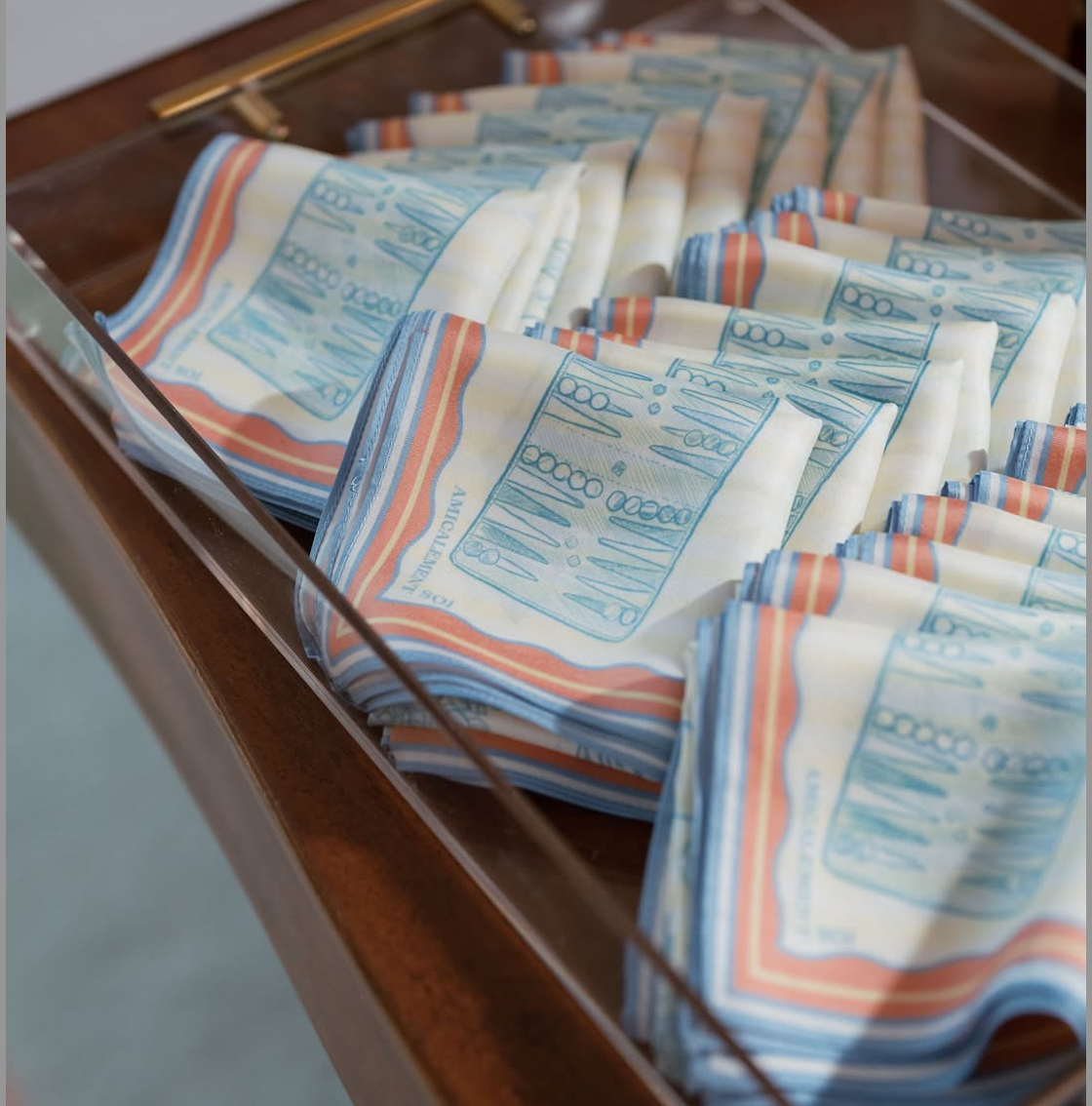
A silk square hand-drawn in a French atelier looks like no other. Its story is traceable, real, worth telling. Placed in a room, it doesn't announce its singularity. It carries it. And the guest attuned to it recognizes it without being told.
It's the exact opposite of the catalog object.
Singularity isn't a finish.
There's a lazy way of talking about singularity in luxury hospitality. A bit of local craft here, an art collaboration there, a signature scent to round it off.
That's not what this is about.
True singularity starts with a simple question: who are we, and what can only exist here? It runs through everything — architecture, service, dining, and the first object placed in the room.
It isn't a decorative detail. It's a statement.
And sincere statements create something marble no longer can: a reason to come back.
What great travelers are really looking for.
It's no longer perfection. They already have that.
It's surprise. The feeling of being somewhere in particular, among people who chose every element for a specific reason. The conviction that the place has a vision — not a marketing position, a real vision — and that it shows through even in the smallest details.
The palace hotels rediscovering their singularity aren't doing it by adding more. They're doing it by choosing better.
Less generic. More intentional.
Guests feel it from the first second. And they remember it long after the last.
Amicalement Soi creates hand-drawn silk squares, made in Paris, produced by a certified Entreprise du Patrimoine Vivant (Living Heritage Company).